





Sociology of Violence
- Introduction
- Sociological Theories
- Caste Violence and Social Hierarchy
- Communal, Racial and Ethnic Violence
- Genocide and Mass Violence
- Violence Against Indigenous Communities
- Violence Against Migrants, Refugees and the Urban Poor
- Everyday Violence
- Institutional Violence
- Cultural Violence
- References
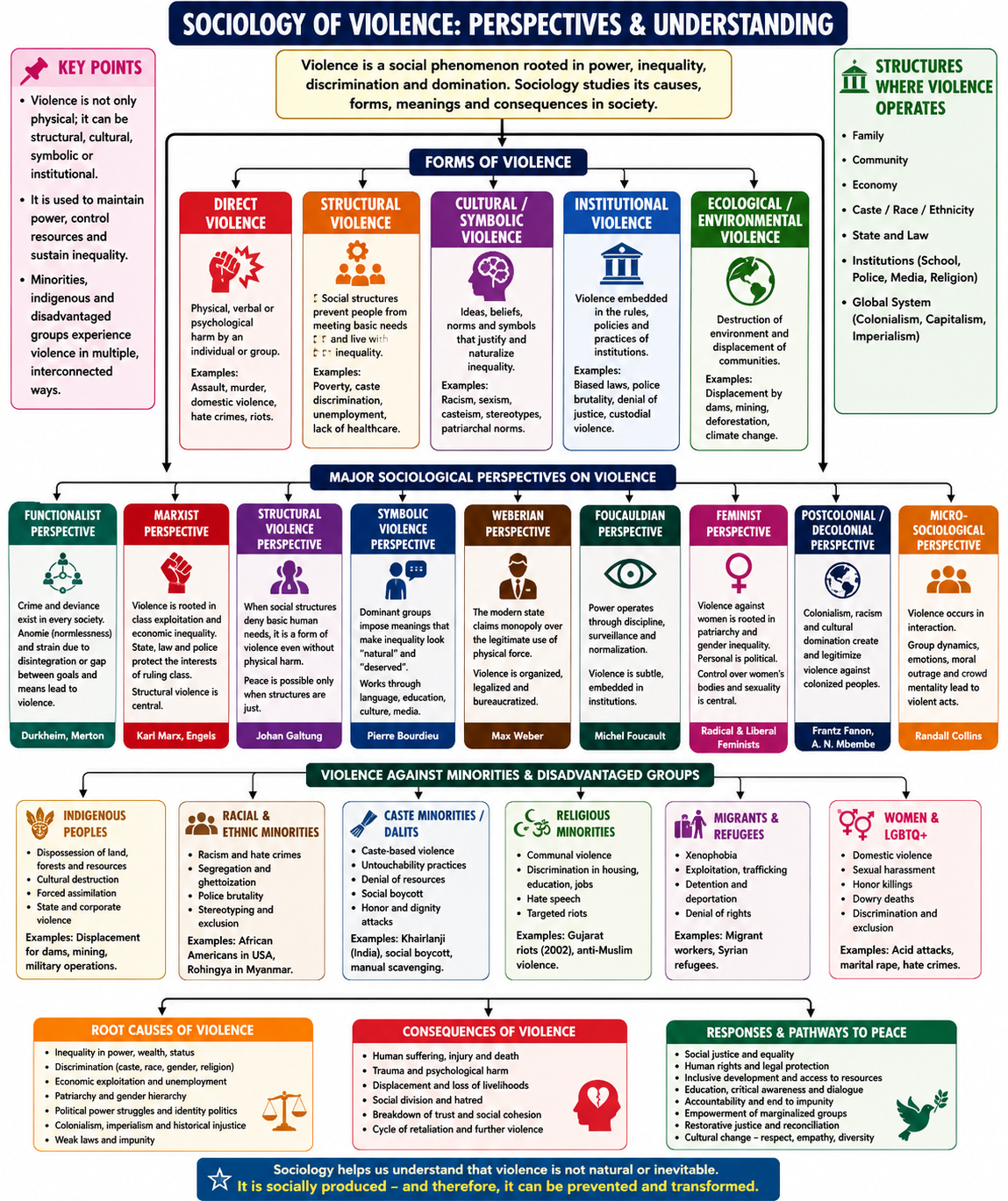
Introduction
The sociology of violence studies violence as a social phenomenon rather than merely an individual act of anger, cruelty or aggression. It asks: Who becomes violent? Who becomes the victim of violence? Which institutions allow violence to continue? Why are some forms of violence condemned while others are justified as law, tradition, development or national security?
Violence is usually understood as physical harm, but sociology gives it a much wider meaning. Violence may be visible, such as murder, assault, rape, lynching, riots, police brutality and war. It may also be invisible, such as poverty, hunger, landlessness, caste humiliation, racism, patriarchy, educational exclusion, forced displacement and cultural erasure. In this wider sense, violence is connected to power. It is used to control bodies, identities, labour, land, resources and political participation.
Minorities, indigenous communities, Dalits, migrants, women, refugees, racial groups, religious minorities and economically disadvantaged people often experience violence not as isolated incidents but as part of a larger social structure. Their vulnerability is produced by history, law, economy, culture, social prejudice and unequal access to institutions.
The sociology of violence therefore helps us understand that violence is not always accidental. It is often organised, normalised and reproduced through institutions, ideologies and everyday social practices.
Sociological Theories
Different sociological theories explain violence from different perspectives:
Functionalist Perspective:
The functionalist perspective sees society as a system made up of interconnected parts such as family, education, religion, law, economy and politics. These institutions are expected to maintain social order. When they fail to regulate behaviour or provide social integration, disorder may occur. Émile Durkheim argued that crime and deviance are normal features of every society because no society can achieve complete moral agreement. However, when social norms become weak or unclear, society enters a condition called anomie. Anomie means normlessness or moral confusion. In such conditions, individuals may feel disconnected from society and may engage in self-destructive or violent behaviour. Durkheim’s work shows that violence cannot be explained only through individual psychology. It must also be understood through the breakdown of social bonds, weak regulation and social disintegration. Robert K. Merton expanded this idea through strain theory. According to Merton, society encourages people to pursue certain goals, such as wealth, success and status. However, not everyone has equal access to legitimate means such as good education, employment, property or social networks. When people are pressured to achieve socially approved goals but are denied the means to achieve them, strain develops. This strain may lead to deviance, crime or violence.
Relevance to Minorities and Disadvantaged Groups
Minority and disadvantaged communities often face blocked opportunities. They may be excluded from quality schools, secure employment, political representation, housing and public services. This exclusion produces frustration and social alienation. However, functionalism must be used carefully. It should not blame disadvantaged groups for violence. Rather, it helps us understand how social exclusion, unemployment and weak institutions can create conditions where violence becomes more likely. Functionalism shows that violence often reflects failures in social integration, moral regulation and institutional support.
Examples:
- Youth violence in urban slums may be linked to unemployment, poor schooling, police harassment and lack of social mobility.
- Communal tension may increase when political institutions fail to provide justice and equal protection.
- Migrant workers may become vulnerable to exploitation and violent conflict when they lack legal protection and stable livelihoods.
Marxist Perspective:
Marxist sociology views violence as a product of class inequality and economic exploitation. According to Marxist theory, society is divided between those who own the means of production and those who sell their labour. This unequal economic structure produces exploitation, poverty and conflict.
From this perspective, violence is not limited to physical attack. Capitalist societies may produce violence through unsafe labour conditions, forced displacement, low wages, hunger, unemployment and denial of basic needs. The state, law and police may appear neutral, but they often protect the interests of dominant economic classes.
Marxist theory is especially useful for understanding violence against indigenous groups and poor communities because much of this violence is connected to land, forests, minerals, labour and resources.
Violence Against Indigenous Groups
Indigenous communities often live in areas rich in forests, minerals, rivers and other natural resources. Development projects such as dams, mines, highways, industrial corridors and plantations frequently require land acquisition. When indigenous communities resist displacement, they may be labelled anti-development, criminal, extremist or anti-national. Marxist analysis argues that this is not accidental. It is connected to capitalist expansion. Land and resources are transferred from communities to corporations, while the affected people lose livelihood, culture and autonomy. Marxism shows that violence is deeply connected to economic power. It reveals how exploitation, dispossession and class domination create conditions of suffering for disadvantaged groups.
Examples:
- Indigenous communities displaced by mining projects lose not only land but also forests, sacred sites, community networks and traditional knowledge systems.
- Workers in informal sectors may face long hours, low wages and unsafe conditions. Their suffering is a form of economic violence.
- Urban poor communities may be evicted from informal settlements in the name of beautification or infrastructure development.
Structural Violence: Johan Galtung
Johan Galtung introduced the concept of structural violence to explain forms of harm that are built into social structures. In direct violence, there is an identifiable attacker. In structural violence, harm occurs because institutions and social arrangements deny people access to basic needs.
Structural violence exists when people suffer or die because of poverty, hunger, lack of healthcare, illiteracy, unsafe housing, unemployment, discrimination or unequal distribution of resources. It is often invisible because it appears normal or natural.
For example, if a child dies because there is no hospital nearby, no transport, no nutrition and no clean water, there may be no single attacker. Yet the child’s death is socially produced. This is structural violence.
Features of Structural Violence
- It is indirect rather than direct.
- It is built into institutions and policies.
- It affects groups unequally.
- It is often normalised by society.
- It causes long-term suffering rather than immediate visible injury.
Minorities and disadvantaged communities frequently experience structural violence through unequal access to education, healthcare, housing, employment and justice. Indigenous groups may face structural violence when their lands are taken, their languages ignored, and their communities denied development on their own terms.
Examples
- High maternal mortality among poor women because of lack of healthcare is structural violence.
- Malnutrition among indigenous children due to displacement and forest loss is structural violence.
- Schools in minority areas lacking teachers, toilets, electricity and learning materials represent structural educational violence.
- Denial of legal aid to poor prisoners is structural injustice.
Structural violence helps us see that inequality itself can be violent. It shifts attention from individual criminals to unjust systems.
Symbolic Violence: Pierre Bourdieu
Pierre Bourdieu developed the concept of symbolic violence to explain how domination operates through culture, language, education, taste, manners and social norms. Symbolic violence is not physical, but it makes inequality appear natural, deserved or inevitable. Dominant groups impose their culture and worldview as superior. Subordinate groups may internalise this domination and begin to see themselves as inferior. This makes symbolic violence extremely powerful because it works with consent, habit and everyday belief.
Symbolic violence works through:
- Language and accent
- School curriculum
- Media representation
- Religious and caste norms
- Gender expectations
- Ideas of merit and respectability
For example, when a tribal language is treated as backward and only dominant languages are valued in schools, indigenous children may feel ashamed of their own culture. This is symbolic violence. Minorities are often represented through stereotypes. They may be described as disloyal, backward, violent, anti-national, criminal or culturally inferior. Such representations prepare society to accept discrimination or even physical violence against them. Caste society produces symbolic violence by associating purity, honour and superiority with dominant castes while attaching stigma to Dalits. Indigenous communities face symbolic violence when their knowledge, dress, food, rituals and ecological practices are dismissed as primitive.
Examples
- A Dalit child being made to sit separately in school reflects symbolic and social violence.
- Media repeatedly associating a minority community with crime produces symbolic violence.
- Mocking indigenous dress, language or rituals reinforces cultural domination.
- Women being taught that obedience and sacrifice are their natural duties is symbolic gender violence.
Symbolic violence shows that domination does not always require physical force. It can operate through ideas, language and culture.
Weberian Perspective:
Max Weber argued that the modern state claims a monopoly over the legitimate use of physical force within a territory. This means that the state alone is considered authorised to use violence through institutions such as the police, army, courts and prisons. Weber’s theory is important because it shows that violence does not disappear in modern society. Instead, it becomes organised, legalised and bureaucratised. State violence may be seen as legitimate when it is carried out in the name of law, order, security or national interest.
Forms of State Violence
- Police firing
- Custodial torture
- Imprisonment
- Military operations
- Border violence
- Surveillance
- Demolition drives
- Emergency laws
Minority and indigenous communities may experience the state differently from dominant groups. They may face over-policing, racial profiling, surveillance, arbitrary detention and harsher punishment. Indigenous resistance may be treated as a security threat rather than a demand for justice.
Examples
- Police brutality against protestors demanding land rights.
- Excessive surveillance of minority neighbourhoods.
- Criminalisation of indigenous activists resisting mining or displacement.
- Custodial violence against poor and marginalised accused persons.
The Weberian perspective helps us understand how violence becomes legitimate when performed by the state. It also raises the question: legitimate for whom, and against whom?
Foucauldian Perspective:
Michel Foucault shifted the study of power from open violence to everyday discipline. In traditional societies, punishment was often public and spectacular. In modern societies, power works through surveillance, classification, examination and normalisation. Foucault argued that institutions such as prisons, schools, hospitals, factories, armies and welfare offices discipline individuals by observing, recording and correcting behaviour. Power becomes internalised because people begin to monitor themselves.
Violence Beyond Physical Force
For Foucault, modern violence is not always about beating or killing. It can involve making people obedient, visible, measurable and controllable.
Examples of Disciplinary Power
- Prison routines that regulate time, movement and behaviour.
- Schools that classify children as intelligent, weak, disciplined or deviant.
- Welfare systems that monitor poor people’s eligibility and behaviour.
- Surveillance cameras and digital databases that track populations.
Minority populations may be subjected to greater surveillance. Indigenous communities may be documented, classified and controlled by state institutions
Their mobility, land use and cultural practices may be regulated by bureaucracy.
Examples
- Identity checks disproportionately targeting migrants or minorities.
- Labelling indigenous resistance as disorder or extremism.
- Surveillance of religious institutions or minority neighbourhoods.
- Prisons filled disproportionately with poor, racialised or caste-oppressed groups.
Foucault helps us understand hidden forms of violence in modern institutions. Power controls people not only by force, but also by discipline, surveillance and classification.
Feminist Perspective:
Feminist sociology argues that violence is deeply connected to patriarchy. Patriarchy is a social system in which men hold greater power over women in family, economy, religion, politics and culture. Gender violence is therefore not merely a private matter. It is a social and structural problem. Forms of gendered violence include domestic violence, sexual assault, dowry violence, honour killing, trafficking, workplace harassment, marital rape, forced marriage and restrictions on women’s mobility.
Intersectionality
Intersectionality explains that women do not experience violence in the same way. A woman’s vulnerability may be shaped by caste, class, religion, race, ethnicity, disability, migration status and age. For example, a poor Dalit woman may face gender violence, caste violence and class exploitation at the same time. A minority woman may face both patriarchy within society and communal violence from outside. Women from minority and indigenous communities are often targeted during conflict because their bodies are treated as symbols of community honour. Sexual violence becomes a weapon of domination, humiliation and collective punishment.
Examples
- Sexual violence during communal riots.
- Violence against Dalit women as a method of caste control.
- Forced sterilisation or reproductive control of indigenous women in some historical contexts.
- Domestic violence hidden by family honour and economic dependence.
Feminist sociology shows that violence is gendered and intersectional. It cannot be understood without examining patriarchy along with caste, class, race, religion and ethnicity.
Postcolonial Perspective
Postcolonial sociology studies how colonialism produced long-lasting systems of domination. Colonial rule was not only political control; it involved military conquest, racial hierarchy, economic extraction, cultural domination and knowledge control. Colonial powers often described indigenous peoples as primitive, uncivilised or backward. This justified conquest, land seizure, missionary control, forced labour and cultural assimilation. Frantz Fanon argued that colonialism was inherently violent because it divided the world into coloniser and colonised, human and inferior, ruler and ruled. Colonial violence entered the body, mind and culture of the colonised.
Forms of Colonial Violence
- Land seizure
- Forced labour
- Massacres
- Cultural destruction
- Language suppression
- Forced conversion
- Residential schools
- Racial segregation
- Criminalisation of indigenous customs
Postcolonial violence continues after formal colonial rule ends. Many states still follow development models that marginalise indigenous people. Colonial stereotypes may continue in textbooks, administration, law and media.
Examples
- Indigenous children being forced into schools that suppress native languages.
- Forest communities being treated as encroachers on their ancestral land.
- Development policies that ignore indigenous consent.
- Racialised policing of former colonial subjects and migrants.
Postcolonial theory shows that violence against indigenous and minority groups is historically rooted. Present-day inequality is often connected to colonial systems of land, knowledge and racial domination.
Caste Violence and Social Hierarchy
Caste violence is a major area of sociological study in India. Caste is not only a system of social classification; it is a system of power, purity, pollution, occupation, marriage control and social exclusion.
Violence is used to maintain caste hierarchy. When Dalits or lower-caste groups challenge traditional power relations, dominant groups may respond with physical violence, social boycott, humiliation or economic punishment.
Forms of Caste Violence
- Physical assault
- Social boycott
- Denial of access to temples, wells or public spaces
- Violence against inter-caste couples
- Manual scavenging and degrading labour
- Sexual violence against Dalit women
- Humiliation in schools and workplaces
- Atrocities over land rights
Caste violence often occurs when oppressed groups assert dignity, equality and constitutional rights. Acts such as wearing certain clothes, riding a horse in a wedding procession, entering a temple, contesting elections or demanding wages may be seen as challenges to caste order.
Examples
- Violence against Dalits for accessing common water sources.
- Attacks on inter-caste marriages.
- Atrocities against Dalit agricultural labourers demanding fair wages.
- Humiliation of Dalit students in educational institutions.
Caste violence is not random. It is a mechanism for preserving social hierarchy and punishing assertion by oppressed groups.
Communal, Racial and Ethnic Violence
Oommunal, racial and ethnic violence occur when social groups are mobilised against each other on the basis of religion, race, language, ethnicity or nationality. Such violence is often presented as spontaneous anger, but sociologists show that it is usually organised through rumours, propaganda, political mobilisation and institutional failure. Charles Tilly analysed collective violence as a form of social and political interaction. Violence becomes possible when groups are mobilised, identities are hardened and authorities either participate, withdraw or fail to intervene.
How Collective Violence Develops
- Creation of fear and suspicion
- Spread of rumours
- Dehumanisation of the target group
- Political speeches and hate propaganda
- Mobilisation of mobs
- Weak or biased policing
- Impunity after violence
Minorities are often portrayed as threats to nation, religion, culture, jobs, security or demographic balance. Once a group is constructed as dangerous, violence against it becomes easier to justify.
Examples
- Anti-minority riots.
- Lynching based on rumours.
- Racial attacks against migrants.
- Ethnic cleansing during civil conflict.
- Hate crimes targeting religious or racial identity.
Role of Media and Digital Platforms
Modern communal and racial violence is often intensified by social media. Fake news, edited videos, hate speech and conspiracy theories can spread rapidly and mobilise fear. Digital violence may precede physical violence. Communal and racial violence is socially produced. It depends on identity politics, propaganda, group mobilisation and failure of institutions.
Genocide and Mass Violence
Genocide is the systematic attempt to destroy a national, ethnic, racial or religious group. Sociology studies genocide not as sudden madness but as a social process. It involves classification, dehumanisation, organisation, propaganda, bureaucracy and mass participation.
Genocide often begins with symbolic violence: the target group is described as dirty, dangerous, disloyal, diseased or less than human. This dehumanisation prepares society to tolerate exclusion, expulsion or killing.
Stages of Genocidal Violence
- Dividing society into “us” and “them”
- Spreading stereotypes and hate propaganda
- Excluding the target group from rights
- Organising militias or state forces
- Isolating victims socially and physically
- Carrying out mass killing, displacement or destruction
- Denying or justifying the violence afterward
Examples
- The Holocaust against Jews in Nazi Germany.
- The Rwandan genocide against Tutsis.
- Ethnic cleansing in different conflict zones like Gaza.
- Colonial genocides against indigenous populations.
Genocide is an extreme form of organised social violence. It grows through ideology, bureaucracy, propaganda and the collapse of moral restraint.
Violence Against Indigenous Communities
Indigenous communities are among the most affected by structural, symbolic and direct violence. Their relationship with land, forest, water and culture is often fundamentally different from capitalist ideas of private property and resource extraction. For many indigenous groups, land is not merely an economic asset. It is connected to identity, ancestors, spirituality, livelihood, medicine, food, language and community life. When land is taken away, the violence is material, cultural and emotional.
Forms of Violence Against Indigenous Groups
Land Alienation
Indigenous people are displaced from ancestral lands for mining, dams, industries, conservation projects or military use.
Resource Extraction
Forests, minerals and rivers are exploited without meaningful consent of local communities.
Cultural Erasure
Languages, rituals, dress, songs, oral traditions and ecological knowledge are dismissed or suppressed.
Criminalisation
Indigenous resistance may be labelled illegal, extremist or anti-development.
Development-Induced Displacement
Projects presented as national progress may destroy local communities.
Environmental Violence
Deforestation, pollution and climate change damage indigenous livelihoods disproportionately
Sociological Importance
Violence against indigenous groups shows how development itself can become violent when it ignores justice, consent and cultural survival.
Violence Against Migrants, Refugees and the Urban Poor
Migrants, refugees and the urban poor experience violence through insecure citizenship, labour exploitation and social exclusion. They are often treated as outsiders, criminals, burdens or threats.
Forms of Violence
- Wage theft
- Unsafe working conditions
- Police harassment
- Evictions
- Xenophobic attacks
- Denial of documents
- Poor housing
- Exclusion from welfare
- Detention and deportation
- Migrant workers trapped in informal labour without contracts.
- Refugees living in camps without full rights.
- Urban slum dwellers facing demolition without rehabilitation.
- Street vendors facing confiscation of goods and harassment.
Violence against migrants and the poor shows how citizenship, class and urban planning can produce exclusion.
Everyday Violence
Everyday violence refers to routine forms of humiliation, fear, insult, exclusion and discrimination that become part of daily life. It may not always appear dramatic, but it shapes people’s sense of dignity and belonging
Examples
- A minority person being repeatedly asked to prove loyalty.
- A Dalit student facing caste jokes in school.
- A tribal person being mocked for language or dress.
- A Muslim tenant being denied housing.
- A migrant worker being abused by employers.
- A woman being restricted from public spaces.
Everyday violence creates psychological harm. It teaches marginalised people that they are unsafe, inferior or unwanted.
Everyday violence shows that oppression is reproduced not only through major events but through ordinary interactions.
Institutional Violence
Institutional violence occurs when formal organisations harm people through policies, neglect, discrimination or unequal treatment. Institutions may include schools, police, courts, hospitals, prisons, welfare departments, banks and workplaces.
Examples
- Schools that discriminate against minority or Dalit children.
- Hospitals that neglect poor patients.
- Police refusing to register complaints from disadvantaged groups.
- Courts where justice is delayed for poor victims.
- Prisons overcrowded with undertrial prisoners from marginalised backgrounds.
Institutional violence is powerful because it is often hidden behind rules and procedures. It may appear legal, technical or bureaucratic, but its effects are deeply unequal. Institutional violence reveals how organisations can reproduce inequality even without openly violent intentions.
Cultural Violence
Johan Galtung also used the idea of cultural violence to describe beliefs, symbols, religion, ideology, language and art that justify direct or structural violence. Cultural violence makes other forms of violence appear acceptable.
Examples
- Caste ideology justifying untouchability.
- Racist theories presenting some groups as inferior.
- Patriarchal beliefs justifying control over women.
- Nationalist propaganda portraying minorities as enemies.
- Development ideology treating indigenous displacement as necessary progress.
Cultural violence provides moral justification for domination. It tells society that violence is natural, deserved or necessary.
The sociology of violence shows that violence is not only an act committed by one individual against another. It is deeply embedded in social structures, institutions, culture, history and power relations. Violence against minorities, indigenous peoples and disadvantaged groups is often produced by long-term inequalities rather than sudden conflict.
A sociological understanding of violence is important because it shifts attention from isolated incidents to deeper causes. It asks society to examine the institutions, ideologies and inequalities that make some lives more vulnerable than others.
True prevention of violence requires more than punishment. It requires equality, justice, representation, dignity, redistribution of resources, protection of minority rights, gender justice, land rights for indigenous peoples and democratic accountability of institutions.
References
Bourdieu, P. (2001). *Masculine Domination*. Stanford University Press.
Collins, R. (2008). *Violence: A Micro-sociological Theory*. Princeton University Press.
Durkheim, É. (1897). *Suicide: A Study in Sociology*.
Fanon, F. (1963). *The Wretched of the Earth*. Grove Press.
Foucault, M. (1995). *Discipline and Punish: The Birth of the Prison*. Vintage.
Galtung, J. (1969). “Violence, Peace, and Peace Research.” *Journal of Peace Research*, 6(3), 167–191.
Merton, R. K. (1938). “Social Structure and Anomie.” *American Sociological Review*, 3(5), 672–682.
Tilly, C. (2003). *The Politics of Collective Violence*. Cambridge University Press.
Weber, M. (1919). “Politics as a Vocation.”



 |
© 2026 sociologyguide |
 |