





Urbanisation
Index
- The Urban Way of Life
- Urbanisation in India: Patterns, Drivers, and Challenges
- Contemporary Thinkers on Urbanisation
- Manuel Castells: Collective Consumption and Urban Movements
- David Harvey: Accumulation by Dispossession and Right to the City
- Saskia Sassen: Global Cities and Expulsions
- Smart Cities Mission and AMRUT: Urban Policy Frameworks in India
- Informal Economy, Migration, and the Urban Poor
- Gender, Caste, and Exclusion in Urban Space
- Environmental Crisis, Sustainability, and the Future of Urbanisation
- Conclusion
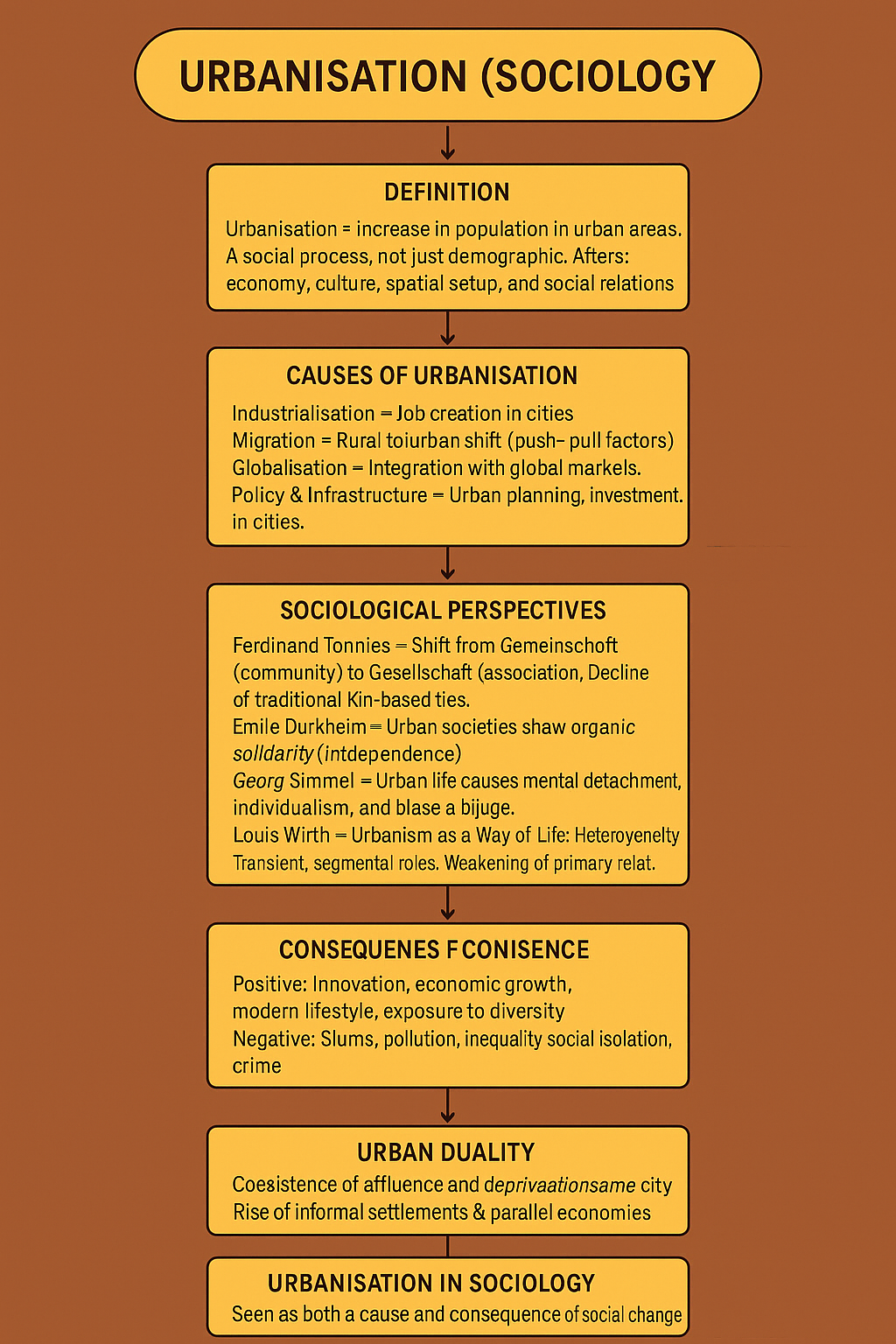
Urbanisation refers to the process by which an increasing proportion of a
population comes to reside in urban areas, leading to the growth and expansion
of towns and cities. It is not merely a demographic shift but a complex social
transformation that alters economic systems, cultural patterns, spatial
arrangements, and social relations. Urbanisation in sociology is understood as
both a cause and consequence of social change—shaped by industrialisation,
migration, globalisation, and policy regimes.
At its core, urbanisation represents a shift from Gemeinschaft to Gesellschaft,
as described by Ferdinand Tönnies—moving from close-knit, tradition-bound
communities to impersonal, contractual, and bureaucratically managed urban
societies. This transition brings with it new forms of social organisation, such
as nuclear families, voluntary associations, and formal economic systems, while
often weakening traditional kinship bonds and community-based controls.
From a functional perspective, urbanisation fosters economic growth by
concentrating labor, capital, and infrastructure. Cities act as hubs of
innovation, trade, services, and education, contributing to national
development. However, this same process also generates dysfunctions—rising
inequality, housing shortages, slums, pollution, crime, and the weakening of
social solidarity.
Urbanisation is closely tied to migration, especially rural-to-urban migration,
which reflects both push factors (poverty, lack of employment, agrarian
distress) and pull factors (job opportunities, better services, modern lifestyles).
This migration fuels the informal sector and unregulated settlements, resulting
in the coexistence of affluence and deprivation within the same urban space—a
phenomenon often called the “urban duality.”
Louis Wirth’s classic work on “Urbanism as a Way of Life” (1938) explains that
urban settings foster a particular mode of life marked by individualism,
rationality, diversity, and social isolation. The city becomes a site of multiple,
transient relationships—where people are constantly surrounded yet often feel
alone. Wirth argues that urbanisation weakens primary relationships and
increases reliance on secondary and impersonal ties.
In the Indian context, urbanisation has accelerated since the post-liberalisation
period of the 1990s, driven by the rise of the service sector, infrastructure
projects, and private real estate. Yet, this growth has been uneven and
exclusionary. Cities like Delhi, Mumbai, and Bangalore have emerged as global
nodes, but millions continue to live in slums with poor sanitation, insecure
tenure, and limited access to education and healthcare.
Urban sociologists have also emphasized the concept of the “Right to the
City”—a demand for more equitable, participatory, and inclusive urban spaces.
This approach critiques top-down planning and advocates for the inclusion of
marginalised groups—slum dwellers, women, migrants, and the urban
poor—in decision-making processes.
Importantly, urbanisation is now deeply intertwined with technology and
surveillance, leading to the rise of “Smart Cities” and “Digital Urbanism.”
While these initiatives promise efficiency and innovation, they also risk creating
“techno-elitist” spaces that exclude the poor and deepen digital divides.
Urbanisation is also a site of resistance and grassroots innovation. Movements
for housing rights, environmental justice, and equitable public transport
represent urban struggles that reflect deeper structural inequalities in Indian
cities. Urbanisation, therefore, is not just a demographic or infrastructural
phenomenon—it is a contested social process shaped by power, class, gender,
caste, and state policy.
Introduction: Understanding Urbanisation as Social Transformation
Urbanisation is not merely the process of increasing concentration of
population in urban areas; it is a profound transformation in the structure of
society, modes of livelihood, spatial arrangements, and cultural life. From a
sociological standpoint, urbanisation signifies a transition from rural, agrarian,
kinship-bound communities to urban, industrialised, and bureaucratic forms
of association. It entails not only demographic and spatial expansion of cities
but also a reorganisation of human relationships, institutions, and cultural
values. Urbanisation reflects the dynamics of capitalism, state policy,
technological change, and global integration, making it a deeply contested and
layered phenomenon.
In the classical sociological tradition, Ferdinand Tönnies distinguished between
Gemeinschaft (community) and Gesellschaft (association), suggesting that
urbanisation symbolised a shift from traditional, emotion-based social ties to
rational, contractual, and impersonal relationships. Emile Durkheim viewed
urban societies as based on organic solidarity—complex interdependence
among specialised individuals. Georg Simmel, in his essay The Metropolis and
Mental Life, noted how urban life fosters rationality, individualism, and a blasé
attitude due to constant sensory overload and anonymity. These thinkers laid
the foundation for understanding urbanisation not just as a spatial shift but as
a reconfiguration of human consciousness and interaction.
The Urban Way of Life: Wirth and the Sociological Imagination
A key sociological text in the study of urbanisation is Louis Wirth’s (1938)
Urbanism as a Way of Life. He argued that the urban environment gives rise to
a distinctive social character defined by heterogeneity, transience, and
segmental roles. Urban life is marked by impersonal, superficial relationships
where primary ties weaken and secondary, formal associations dominate. The
urbanite develops a sense of reserve, emotional detachment, and tolerance of
diversity. Wirth’s formulation remains relevant in explaining the nature of
modern cities, though scholars now emphasise that urban experiences also
include resistance, collective identity, and new forms of solidarity.
In India, the coexistence of tradition and modernity within cities challenges
some of Wirth’s assumptions. For instance, kinship, caste networks, and
religious identities continue to influence urban housing, labour, and marriage
patterns. Yet, urbanisation has undeniably altered the landscape of everyday
life—shifting people from caste-based occupations to service sector jobs,
transforming family structures, and introducing new aspirations.
Urbanisation in India: Patterns, Drivers, and Challenges
India’s urbanisation trajectory has been uneven, informal, and exclusionary.
According to Census 2011, around 31% of India’s population lived in urban
areas—a figure projected to rise to nearly 40% by 2036. Unlike the West, where
urbanisation was driven by industrialisation, in India, it has been shaped by
migration, reclassification of rural areas, and urban sprawl. Post-1991 economic
liberalisation accelerated urban growth, particularly in sectors like IT, real
estate, retail, and logistics. Cities such as Bengaluru, Hyderabad, and
Gurugram became global service hubs, attracting investments and skilled
migrants.
Yet, this urban growth has been deeply unequal. A handful of metropolitan
regions absorb most of the investment and migration, while smaller towns
struggle with poor infrastructure. Furthermore, rural-urban migration often
leads to informal settlements or slums, where migrants face precarity, poor
sanitation, insecure tenure, and limited access to services. The informal sector
employs over 80% of the urban workforce, revealing a paradox—cities produce
wealth but fail to ensure dignified lives for most of their inhabitants.
Contemporary Thinkers on Urbanisation: Castells, Harvey, and Sassen
Contemporary sociological and urban theory has added depth to the
understanding of urbanisation by linking it to capital accumulation,
globalisation, and resistance. Manuel Castells, in his theory of collective
consumption, emphasised how the state’s provision of housing, transport,
education, and public services is central to sustaining capitalist urbanisation.
He argued that when these services are denied or commodified, urban
movements emerge in resistance—particularly among the working classes and
urban poor. In India, such movements are evident in slum dwellers’ struggles
for tenure, protests against forced evictions, and campaigns for inclusive
housing.
David Harvey, a Marxist geographer, introduced the idea of “accumulation by
dispossession”, where urban land and resources are privatised, commodified,
and used for speculative investment. Cities become centres for capital
circulation through real estate development, infrastructure projects, and
gentrification. This logic is visible in Indian megacities—where land
acquisition for metro rail, expressways, or smart city projects often displaces
informal workers and indigenous communities. Harvey’s call for a “Right to
the City” is a demand for reclaiming urban spaces as democratic, participatory,
and socially just.
Saskia Sassen, in her work on the Global City, highlights how cities become
command centres of finance, migration, and information flows. Global cities
like New York, London, and Tokyo are replicated in Indian contexts such as
Mumbai, Bengaluru, and Gurugram. These cities are marked by luxury
enclaves, financial districts, and IT parks—coexisting with slums, informal
markets, and urban villages. Sassen’s idea of “expulsions”—the systemic
pushing out of the poor from urban space—resonates with how Indian cities segregate and invisibilise low-income populations.
Smart Cities, AMRUT, and Urban Policy in India
In response to the challenges of rapid and chaotic urbanisation, the
Government of India launched the Smart Cities Mission in 2015. This
initiative aimed to develop 100 cities as digitally enabled, efficient, and
citizen-friendly urban centres using ICT (Information and Communication
Technology). It focused on area-based development, smart governance,
sustainable infrastructure, and digital surveillance. While ambitious in scope,
critics argue that smart city projects have largely served real estate interests,
created “enclaves of development”, and excluded informal workers and slum
populations.
The AMRUT (Atal Mission for Rejuvenation and Urban Transformation)
programme was introduced alongside Smart Cities to improve basic urban
infrastructure—such as water supply, sanitation, sewage, non-motorised
transport, and green spaces—in smaller cities. AMRUT aimed for a more
inclusive development model, but its success has been constrained by weak
urban local bodies, lack of funding, and limited citizen participation.
Overall, Indian urban policy has often been technocratic and top-down, with a
focus on aesthetics, security, and investment attractiveness rather than equity or
inclusion. Urban governance remains fragmented between multiple agencies
with overlapping responsibilities. The absence of strong elected municipal
leadership and participatory planning has weakened the ability to respond to
local needs—particularly of the urban poor, migrants, and marginalised
groups.
Informal Economy, Migration, and the Urban Poor
The urban informal economy forms the backbone of Indian cities. Street
vendors, rickshaw pullers, domestic workers, construction labourers, and gig
workers ensure that cities run efficiently, yet they remain excluded from social
security, housing, healthcare, and legal recognition. Informality is not just an
economic condition but a political status—marked by precarity, invisibility,
and systemic neglect.
Urbanisation in India is also closely linked to migration, particularly
rural-to-urban migration. People migrate in search of better jobs, education, or
escaping caste oppression, agrarian crisis, or climate disasters. However, most
migrants find themselves absorbed into the informal sector, with limited
upward mobility. They face discrimination in housing, policing, and access to
identity documents. The COVID-19 lockdown of 2020 exposed the brutal
exclusion of migrants—millions walked hundreds of kilometres back to their
villages, highlighting the absence of urban social protection and planning for
the poor
Gender, Caste, and Exclusion in Urban Space
Urbanisation is not a neutral or equal process—it is shaped by power, privilege,
and structural inequalities. Women face multiple barriers in accessing safe,
inclusive, and enabling urban environments. Lack of public toilets, inadequate
lighting, and gender-blind transport systems restrict their mobility.
Employment opportunities in cities are often gendered and poorly paid, while
patriarchal norms continue to regulate women’s freedom and visibility.
Caste also remains a powerful axis of urban exclusion. Dalits and Muslims are
often confined to segregated colonies, denied housing in upper-caste localities,
and subjected to everyday discrimination. Urban planning rarely considers
these structural oppressions, and gentrification often displaces vulnerable
communities in the name of beautification or infrastructure development.
In this context, urban space becomes a site of both violence and struggle. From
anti-CAA protests at Shaheen Bagh to housing rights movements in Mumbai,
cities also offer platforms for collective resistance and new solidarities
Environmental Crisis, Sustainability, and the Future of Urbanisation
Rapid urbanisation has led to severe ecological degradation, with air pollution,
groundwater depletion, waste mismanagement, and the loss of green cover
becoming critical challenges. Cities like Delhi, Kanpur, and Varanasi routinely
feature among the world’s most polluted. Unplanned construction,
concretisation, and shrinking wetlands have made Indian cities highly
vulnerable to floods, heatwaves, and water scarcity.
Sustainable urbanisation requires a rethinking of priorities—from car-centric
models to public transport, from vertical real estate to affordable housing, and
from techno-fixes to eco-sensitive planning. Climate-resilient urban planning
must integrate the voices of the urban poor, street vendors, and slum residents
who are often the worst affected yet least responsible for environmental
damage.
Conclusion
Urbanisation in India is at a critical juncture. On one hand, cities represent opportunity, aspiration, innovation, and connectivity. On the other, they reflect inequality, exclusion, surveillance, and unsustainability. Sociologists remind us that cities are not just physical entities but spaces of meaning, conflict, and negotiation. Reclaiming urbanisation as a just and democratic process requires rethinking urban planning beyond infrastructure and investment. It calls for empowering local governance, recognising informal contributions, protecting rights to housing and mobility, and ensuring inclusion across caste, class, and gender. Cities must be seen as shared commons, not commodities. As David Harvey insists, the Right to the City is not only about access but about the power to shape the city’s future—one that is equitable, participatory, and sustainable
References
- Castells, Manuel (1977). The Urban Question: A Marxist Approach to Urban Sociology. London: Edward Arnold
- Harvey, David (2008). The Right to the City. New Left Review, 53, Sept–Oct
- Sassen, Saskia (2001). The GPrinceton University Press
- Wirth, Louis (1938). Urbanism as a Way of Life. American Journal of Sociology, Vol. 44(1).
- Simmel, Georg (1903). The Metropolis and Mental Life.
- India Census (2011). Urban Population Data. Office of the Registrar General & Census Commissioner.
- Ministry of Housing and Urban Affairs (2015–2023). Smart Cities Mission Guidelines and AMRUT Progress Reports. Government of India.
- Dupont, Véronique (2007). Conflicting Stakes and Governance in the Peripheries of Large Indian Metropolises – An Introduction. Cities, 24(2).
- Baviskar, Amita (2003). Between Violence and Desire: Space, Power, and Identity in the Making of Metropolitan Delhi. International Social Science Journal.
|
|



 |
© 2026 sociologyguide |
 |