










Home » Social Thinkers » R.K Merton
R.K Merton
Robert King Merton was a distinguished sociologist perhaps best known for having coined the phrase "self-fulfilling prophecy." He also coined many other phrases that have gone into everyday use, such as "role model" and "unintended consequences". He was heavily influenced by Pitirim Sorokin who tried to balance large-scale theorizing with a strong interest in empirical research and statistical studies. This and Paul Lazarsfeld influenced Merton to occupy himself with middle-range theories.
Theories of the middle range:
Middle range theories of R.K Merton came as rejection of mega theory of Parsonian sociology. His theory advocates that theory building in sociology should not be governed by intellectual aggression or academic speculation. Sociological theories cannot afford to be rogue, unrealistic, jargon focused and simply logical. Rather theories are developed in sociology to arrange the empirical facts in a consolidated manner. Hence sociological theories should be fact driven. The social theories should be coming out of facts to explain the facts in a systematic manner. Instead of being concerned about mega speculations that there is a social system where there is exchange, negotiation, convergence, consequently control and integration sociology must look into the actual problems and issues related to empirical situations.
During 1960s in America, political corruption, ethnic conflict, deviant behavior was largely manifested and Merton took interest in studying them and explained all the emergent conditions using simply designed theoretical frameworks. Subsequently he identified these theories as middle range theories. As a reaction to mega theories Merton advocates that these theories are highly speculative and do not correspond to the empirical realities. They make an attempt to study every possible dimension of social reality that is not possible in the field of sociology. The degree of abstraction is quite high when concepts are chosen to develop such theories therefore these kind of mega theories do not have much of relevance to understand the essence of social reality. Hence sociology must have to reject mega theoretical constructs replacing them by middle range theories.
Merton is not comfortable with the use of natural science theories in the field of sociology. He advocates that theories in natural science come out of cumulative research made on a given problem by large body of scholars in time and space. It is possible on part of a natural scientist to modify, amend or revise the theories of his predecessors applying such theories to contemporary problems and issues. Natural phenomena being static, cumulative research on them become possible and a broad agreement among the researchers studying the same problem gives rise to the growth of unified theories in the field of natural sciences.
In the field of sociology the form of capitalism, patterns of democracy, role of family as a group keeps changing in time and space. Therefore cumulative research should largely speak about diversity, variabilities present in their structure and functions for which mega theories in sociology may be necessity to natural science but it is absolutely unwanted for sociological research. Sociology must have to go for middle range theories than striving for scientific status extending natural science theories into the field of sociological research. Sociology should not be compared with natural sciences. Merton borrows substantive ideas from sociology of Weber as the basic problem with ideal type construct is that it asserts that totality of reality cannot be studied by sociology therefore sociology must have to study the essence of reality. To Merton sociology is encountering with the problem of identification of the issues for conducting research that needs to be resolved. The weberian sociology is committed to macroscopic issues that are difficult to study in every possible detail. If sociological research considers that it must have to address to microscopic structures then it will not be difficult for sociologists to understand various dimensions to a given social reality therefore Merton takes interest in the study of political corruption, machine politics considering these issues/problems are subjected to complete scientific investigation.
|
|
Middle Range theories in sociology advocate that how to sociological research facts are important than theories. It gives rise to a situation where facts speak for themselves. These theories are small understandable, on controversial universally acceptable conceptual devices coming out of a given empirical situation having capacity to explain same or different types of situations without any possible ambiguities or controversies. For instance reference group theory, concept of in-group or out-group are defined as middle range theories which can provide a guide to sociological research in time and space.
Clarifying functional analysis:
Merton argues that the central orientation of functionalism is in interpreting data by their consequences for larger structures in which they are implicated. Like Durkheim and Parsons he analyzes society with reference to whether cultural and social structures are well or badly integrated, is interested in the persistence of societies and defines functions that make for the adaptation of a given system. Finally, Merton thinks that shared values are central in explaining how societies and institutions work.However he disagrees with Parsons on some issues which will be brought to attention in the following part.
Dysfunctions:
Parsons' work tends to imply that all institutions are inherently good for society. Merton emphasizes the existence of dysfunctions. He thinks that something may have consequences that are generally dysfunctional or which are dysfunctional for some and functional for others. On this point he approaches conflict theory, although he does believe that institutions and values CAN be functional for society as a whole. Merton states that only by recognizing the dysfunctional aspects of institutions, can we explain the development and persistence of alternatives. Merton's concept of dysfunctions is also central to his argument that functionalism is not essentially conservative.
Manifest and latent functions:
Manifest functions are the consequences that people observe or expect, latent functions are those that are neither recognized nor intended. While Parsons tends to emphasize the manifest functions of social behavior, Merton sees attention to latent functions as increasing the understanding of society: the distinction between manifest and latent forces the sociologist to go beyond the reasons individuals give for their actions or for the existence of customs and institutions; it makes them look for other social consequences that allow these practices' survival and illuminate the way society works.Dysfunctions can also be manifest or latent. Manifest dysfunctions include traffic jams, closed streets, piles of garbage, and a shortage of clean public toilets. Latent dysfunctions might include people missing work after the event to recover.
Functional alternatives
Functionalists believe societies must have certain characteristics in order to survive. Merton shares this view but stresses that at the same time particular institutions are not the only ones able to fulfill these functions; a wide range of functional alternatives may be able to perform the same task. This notion of functional alternative is important because it alerts sociologists to the similar functions different institutions may perform and it further reduces the tendency of functionalism to imply approval of the status quo.
Merton's theory of deviance
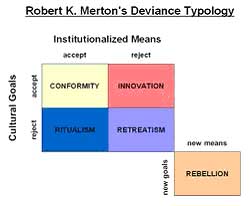
Merton's structural-functional idea of deviance and anomie.
The term anomie, derived from Emile Durkheim, for Merton means: a discontinuity between cultural goals and the legitimate means available for reaching them. Applied to the United States he sees the American dream as an emphasis on the goal of monetary success but without the corresponding emphasis on the legitimate avenues to march toward this goal. This leads to a considerable amount of (the Parsonian term of) deviance. This theory is commonly used in the study of Criminology. (Specifically Strain Theory).| Cultural goals | Institutionalized means | Modes of adaptation |
| + | + | Conformity |
| + | - | Innovation |
| - | + | Ritualism |
| - | - | Retreatism |
| ± | ± | Rebellion |
Conformity is the attaining of societal goals by societal accepted means, while innovation is the attaining of those goals in unaccepted ways. Ritualism is the acceptance of the means but the forfeit of the goals. Retreatism is the rejection of both the means and the goals and rebellion is a combination of rejection of societal goals and means and a substitution of other goals and means. Innovation and ritualism are the pure cases of anomie as Merton defined it because in both cases there is a discontinuity between goals and means.
Sociology of science
Merton carried out extensive research into the sociology of science, developing the Mertonian norms of science. This is a list of ideals that scientists should strive to attain, specifically:



 |
© 2024 Sociology Guide.Com |
 |